Before they took his cell phone, Joseph* called his wife. He had been arrested by ICE agents just as he was dropping off their two daughters at school. He didn’t know what would happen or how long it would all take. The ICE agents didn’t care that he had been in a legalizing process for his green card.
Joseph’s arrest is one more example of the approach being used by ICE police to identify foreign looking and undocumented persons in public places including hardware store parking lots, schools, day care centers, car washes and other places of business that typically employ immigrants in low-wage jobs. As part of Trump’s anti-immigrant agenda the blatant racial profiling strategy used by ICE was challenged but ultimately endorsed by the U.S. Supreme Court. Once arrested, Joseph was treated like a criminal — he was housed in a facility operated by a private prison company in Tacoma, hundreds of miles from his family.
Now it was going to be up to his wife Maria to care for their children. Maria contacted members of their church. They looked for help. They couldn’t find any locally, not for lawyers and certainly not for financial aid for the family undergoing an ICE attack and dealing with the subsequent financial distress and psychological trauma. During this time the Hispanic community responded to the family’s predicament with a fundraising effort involving making and selling tamales to come up with enough money to sustain the family and pay for a release bond. A month later, with no criminal record in his background and demonstrating that he’d been working to legalize his status, Joseph was declared eligible for release from detention, upon payment of the $10,000 bond.
Because what happened to Joseph and his family came as a shock to his neighbors and the church he and his family attend, it took time and effort to find support services and to raise monies to help the family with rent and groceries. Today, however, that small community has learned how to come together and respond to the threat ICE poses to immigrants in their communities and are engaged in daily grassroots resistance organizing.
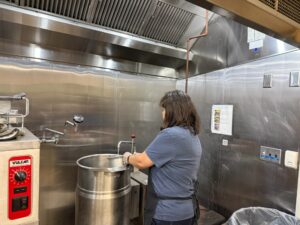
“Many people are afraid to leave the house” said the church member who reached out for help and information after her friend’s husband was picked up. So, a few weeks ago people from at least three Catholic parishes in the Seattle Archdiocese gathered in a big kitchen and began making tamales. Because Maria and her children had been helped by community members in the first tamalada,** she wanted to give back and volunteered to work in the bigger tamalada. They pulled together resources to produce almost 2600 tamales for the Life, Peace and Justice program of the governing Parish which called this fundraising effort the Food for Dignity project.
From pre-sales and donations this small community figured out an efficient and low-cost way to purchase the ingredients of cornmeal masa, meats, vegetables, sauces and corn husks to set up a food production line that ultimately resulted in 2,514 delicious tamales. Their arrangement was to turn over the tamales on a pre-sale arrangement through their parish and to deliver the profits from sales to another nonprofit providing direct relief to immigrant families impacted by ICE’s arrest of their spouses.
The compassionate activism in this small community arose from stories coming out of several parishes about what is happening to members of their church following ICE raids. They also helped another church member and his son. Sadly, Peter was picked up by a “bounty hunter,“ presumably a non-government person who endorses Trump’s anti-immigrant agenda and is rewarded somehow by ICE or the MAGA community to turn in “illegals.” Peter’s only son was terrified while his father was gone an entire month. Like the case of Joseph he too was targeted because he looked like an immigrant and was treated like a criminal. He too was detained for a month in a prison-like facility and was eventually released because of course, he committed no crime.
“Our goal is to let those people targeted by ICE know, you are not alone, we are here for you.”
_____________________
*The names of the individuals have been changed to protect their privacy.
**A tamalada is a tamale-making party, or a gathering of friends and family to make large quantities of tamales.